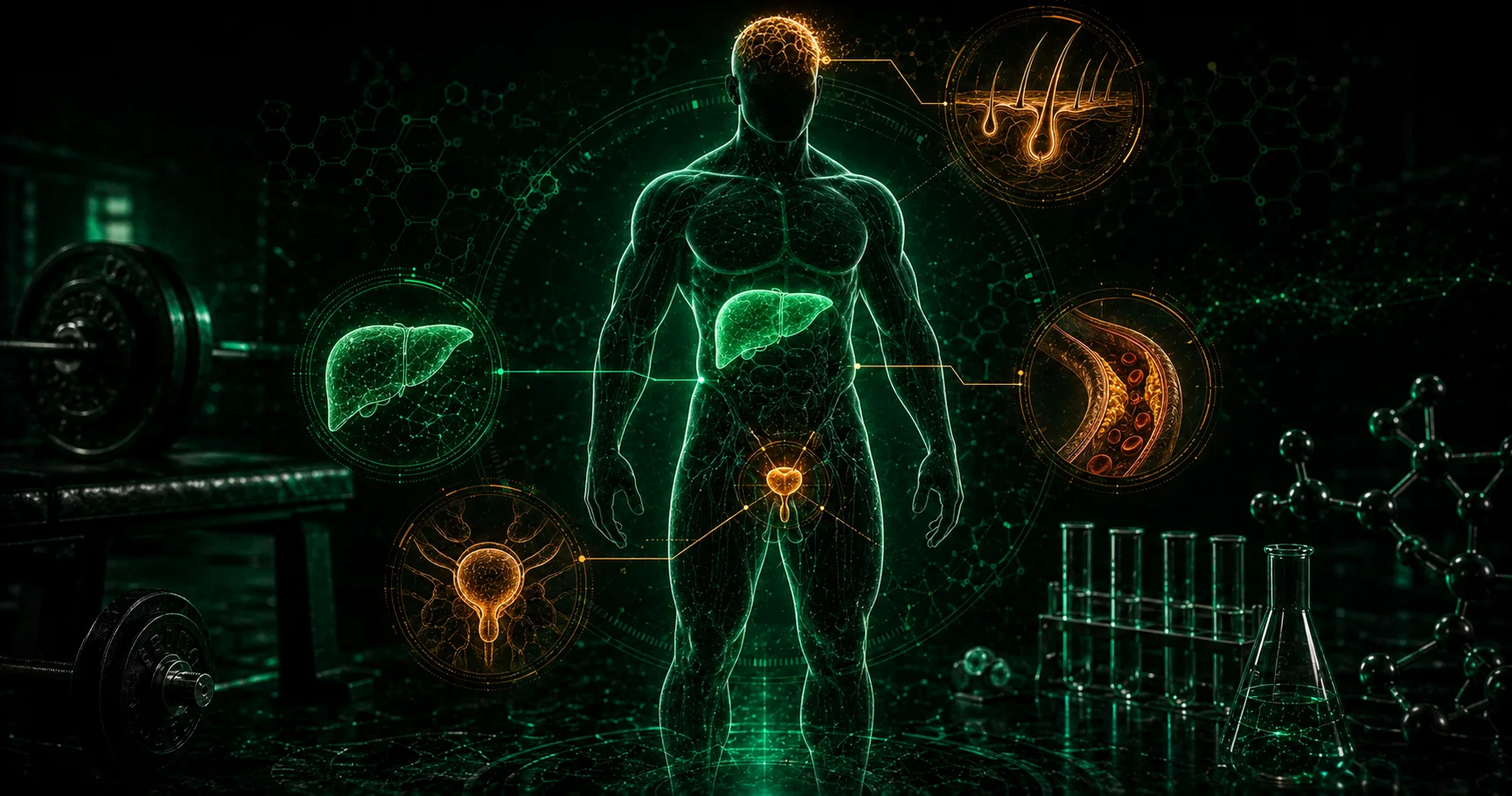
Proviron Side Effects: The Full Risk Profile for Men
Proviron side effects explained: androgenic risk, hair loss, cardiovascular impact, liver safety, and HPTA suppression with real dose-specific thresholds.
What Makes Mesterolone Uniquely Androgenic Among Oral Compounds
Most men researching proviron side effects encounter the same short list: acne, hair loss, maybe a cholesterol note. That list is incomplete. Without understanding the mechanisms behind those risks, you cannot accurately judge how they apply to your situation, your genetics, your dose, your cycle structure. The Proviron complete reference covers the compound as a whole.
Mesterolone carries an anabolic-to-androgenic ratio of approximately 30 to 40:150 to 200. That places it three to five times more androgenic than anabolic, one of the highest androgenic-to-anabolic ratios among all oral compounds. Testosterone sits at 100:100 for reference. Nandrolone sits at 125:37. Mesterolone's androgenic activity is extreme relative to any muscle-building benefit, which means the side effect profile is driven almost entirely by androgenic mechanisms.
Structurally, proviron is a 1-methylated dihydrotestosterone (DHT) derivative. The 1-methyl modification at C1 prevents deactivation by 3-alpha-hydroxysteroid dehydrogenase (3α-HSD), the enzyme that normally inactivates DHT in scalp and prostate tissue. The consequence: mesterolone sustains androgenic activity in the two tissues most vulnerable to androgenic damage, hair follicles and prostate cells, for longer than endogenous DHT itself would.
Proviron does not require 5-alpha reductase conversion to become active at androgen receptors. It arrives already in DHT-equivalent form. This single fact cascades across the entire risk profile in ways that are almost universally misrepresented in online bodybuilding content.
Androgenic Effects at Standard Doses
At 50 to 100mg/day, users should expect some combination of the following based on individual predisposition:
- 1Accelerated male pattern baldness in genetically susceptible men
- 2Increased oily skin and acne, concentrated on the back and shoulders
- 3Enhanced body and facial hair growth in androgen-sensitive areas
- 4Dose-dependent prostate tissue stimulation
- 5Measurable HDL suppression sustained across the cycle
Proviron Hair Loss: Why Finasteride Cannot Protect You
Proviron hair loss is the side effect that catches men most off guard, specifically those who assume they can manage it with the same tools they use to manage hair loss from testosterone or other AAS.
With testosterone-based compounds, 5-alpha reductase converts a fraction of circulating testosterone into DHT at the scalp. Finasteride and dutasteride block this conversion step, reducing scalp DHT concentrations and slowing follicle miniaturization. That mechanism depends entirely on 5-alpha reductase being the bottleneck that produces DHT at target tissue.
Mesterolone bypasses that step completely. Proviron is already a DHT analog, it does not require 5-alpha reductase conversion to exert full androgenic activity at hair follicles. Finasteride has no substrate to block. Taking finasteride alongside mesterolone reduces conversion of your baseline testosterone to DHT, which is counterproductive since mesterolone is often used precisely to enhance androgen activity, while doing absolutely nothing to limit mesterolone's DHT-equivalent exposure at the scalp.
The 1-methyl modification compounds this problem significantly. Because 3α-HSD cannot efficiently inactivate mesterolone in scalp tissue, androgenic exposure at the follicle persists beyond what endogenous DHT would produce. Men with early-stage male pattern baldness, thinning at the temples, or a first-degree relative with significant MPB face meaningful acceleration with no pharmacological off-switch. There is no 5-ARI solution. There is no topical workaround that addresses the androgenic mechanism. Discontinuation is the only effective intervention.
Men carrying the MPB gene who run mesterolone at 75mg/day for 12 weeks can accelerate follicle miniaturization equivalent to 2 to 3 years of natural progression, and unlike DHT-driven loss from testosterone, no finasteride or dutasteride will slow it.
Topical minoxidil may support follicle health through a separate VEGF pathway and could offer marginal benefit, but it does not interrupt the androgenic signaling driving the damage. For men where hair retention is a firm priority, the risk-benefit calculation on mesterolone does not resolve favorably.
Cardiovascular Impact: Lipids, LDH, and the Research You Haven't Seen
The cardiovascular dimension of proviron side effects is the most consistently underplayed risk in this compound's profile. It is frequently positioned as mild compared to aggressive mass-building injectables, but the lipid and cardiac marker data tells a more complicated story. How the DHT profile affects erectile function is covered in can Proviron cause ED.
At bodybuilding doses of 50 to 100mg/day, mesterolone can lower HDL cholesterol, as androgens generally do; users report a smaller drop than with oral 17-alpha-alkylated steroids, but no study has measured it. HDL performs reverse cholesterol transport, it removes lipids from arterial walls and returns them to the liver for processing. Any sustained drop in HDL over a 12 to 16 week cycle shifts cardiovascular risk, even when LDL changes vary between individuals.
A PubMed study examined mesterolone's cardiovascular effects in animal models and documented adverse cardiac remodeling alongside worsened lipoprotein profiles. Critically, aerobic exercise training during the study attenuated but did not eliminate these cardiovascular harms, a finding relevant to men who assume consistent cardio neutralizes the lipid impact of their cycle.
LDH (lactate dehydrogenase) elevation is a cardiovascular marker almost never discussed in bodybuilding content. LDH is released when cardiac or skeletal muscle cells experience damage or significant stress. Elevations observed in mesterolone users at higher doses suggest a degree of cardiac muscle stress that does not show up in a standard lipid panel. Including LDH in bloodwork is a practical step that is rarely taken.
Cardiovascular Monitoring Protocol
HDL cholesterol
Week 0, Week 6
Below 40 mg/dL: reduce dose
LDL cholesterol
Week 0, Week 6
Above 130 mg/dL: monitor closely
LDH
Week 0, Week 8
Above 250 U/L: consider stopping
Proviron Liver Risk: Better Than Other Orals, With Important Caveats
Proviron liver concerns are one area where the compound's relatively mild reputation is largely deserved, but understanding why clarifies exactly where the limits of that reassurance end.
The primary driver of hepatotoxicity in oral anabolic steroids is 17-alpha alkylation. This structural modification allows compounds like Dianabol, Anadrol, and oral Winstrol to survive first-pass liver metabolism, but it imposes significant hepatic stress in the process. ALT and AST elevations of three to five times the upper limit of normal are routine with 17-AA oral use over a standard cycle.
Mesterolone is not 17-alpha alkylated. Its resistance to first-pass degradation comes from the 1-methyl modification, a different structural mechanism that does not impose the same hepatic burden. ALT and AST elevations from proviron alone are typically mild and transient. Most clinical monitoring of mesterolone users at standard doses shows hepatic enzyme changes well within normal reference ranges.
This does not mean liver monitoring is irrelevant. The mesterolone side effects picture on liver health changes when the compound is stacked alongside hepatotoxic agents, injectable stanozolol, 17-AA orals, or sustained high-dose alcohol use. Combined hepatic loads accumulate regardless of individual compound profiles, and mesterolone adds some hepatic burden even if it is lower than alternatives.
Proviron is not 17-alpha-alkylated, and users on 50mg/day rarely report meaningful ALT rises, in sharp contrast to the large ALT spikes common on Dianabol or Anadrol cycles; no trial has quantified this.
The takeaway: mesterolone's liver safety advantage over 17-AA orals is real and meaningful, but it is not a reason to skip hepatic monitoring, particularly when stacking.
HPTA Suppression: Dose Thresholds That Almost No Content Covers
The claim that proviron is suppression-neutral is one of the most consequential errors circulating in bodybuilding communities, with its most dangerous expression in post-cycle therapy protocols. Dose thresholds by goal are in the Proviron dosage guide.
The clinical reality is dose-dependent in a way that almost no forum post or article specifies clearly. At 25mg/day, LH and FSH suppression is subclinical in most men. Blood values typically remain within reference ranges, though trending toward the lower end of normal. This dose has a place in TRT optimization or select therapeutic protocols where the suppressive impact is acceptable.
At 75 to 150mg/day, gonadotropin suppression becomes measurable and consistent. LH and FSH values fall detectably in blood work at these doses. This is confirmed in both clinical pharmacology literature and forum-sourced blood work data from users who have tracked hormone panels during mesterolone use. The suppression is dose-dependent, and it slows HPTA recovery in direct proportion to how long it is sustained.
The PCT myth is the dangerous downstream consequence of ignoring this. Mesterolone is frequently used as a solo PCT compound or bridged across cycle transitions. The logic offered is that it does not aromatize, preserves libido during recovery, and supports androgenic tone. All of that is true. What is also true: it suppresses gonadotropins, which means solo mesterolone post-cycle actively delays HPTA recovery rather than supporting it. Using mesterolone during PCT without SERMs produces the subjective experience of functional recovery, libido, energy, mood, while actual endogenous testosterone production remains suppressed.
LH/FSH Impact by Daily Dose
25mg/day
Subclinical
Usually within range
50mg/day
Mild suppression
May trend low-normal
75 to 150mg/day
Measurable suppression
Consistently detected
If mesterolone is used in a cycle, it should be discontinued at minimum two weeks before SERM-based PCT begins, not bridged through it. Low-dose mesterolone can be reintroduced once LH and FSH are rising and gonadotropin recovery is confirmed by blood work, where it can support libido without significantly impeding ongoing HPTA normalization.
Prostate Risk: The Warning Nobody Includes
The prostate warning is almost universally absent from discussions of proviron androgenic effects, yet it is the risk most directly relevant to the older male demographic that uses this compound at the highest rates.
The 1-methyl modification that prevents 3α-HSD inactivation in scalp tissue has the same effect in prostate tissue. Mesterolone sustains androgenic activity at the prostate for longer than endogenous DHT would, with the same absence of 5-ARI protection. For younger men with no prostate history, this creates a real but manageable risk level. For men over 45, men with diagnosed benign prostatic hyperplasia (BPH), or men stacking mesterolone on top of TRT-level testosterone, the prostatic androgenic load becomes clinically significant.
Symptoms that warrant immediate attention during mesterolone use include increased urinary frequency, reduced stream force, difficulty initiating urination, incomplete bladder emptying, and increased nocturia. Any of these emerging during a cycle calls for PSA testing and either dose reduction or discontinuation depending on findings.
Finasteride and dutasteride will not protect the prostate from mesterolone for exactly the same reason they cannot protect hair follicles: 5-alpha reductase is not the activation step for this compound. Men with BPH diagnosis, elevated PSA baseline, or first-degree family history of prostate cancer should not use mesterolone.
Female Virilization: Provironum Is Not Appropriate for Women
Provironum side effects in women are severe and some are irreversible. The compound's extreme androgenic-to-anabolic ratio means virilization, voice deepening, clitoral enlargement, facial hair growth, menstrual disruption, occurs at doses far below any threshold that would produce meaningful performance benefit. There is no viable therapeutic window for female bodybuilding or athletic use. Women who want androgenic enhancement without permanent virilization risk have compounds with far more favorable androgenic profiles available to them. Mesterolone is not one of them.
Managing Proviron Side Effects: What Is and Is Not Controllable
For men who have assessed the complete risk picture and choose to proceed, managing proviron side effects comes down to realistic dose discipline, a structured monitoring protocol, and accurate expectations about which risks can be reduced and which cannot. Tablet forms and timing are covered in Proviron 25mg.
Dose and cycle length. Keeping doses at 25 to 50mg/day and limiting cycles to 10 to 12 weeks minimizes HDL suppression, keeps gonadotropin suppression subclinical at the lower end of that range, and limits cumulative androgenic exposure at scalp and prostate. Doses above 100mg/day increase every measurable risk marker without proportional benefit for most users' stated goals.
Bloodwork protocol. Pre-cycle baseline should include: total and free testosterone, LH, FSH, HDL, LDL, LDH, ALT, AST, PSA, and hematocrit. Mid-cycle bloodwork at week six for lipid panel and liver enzymes. Post-cycle at four to six weeks into recovery for full hormone panel assessment.
Hair loss. No pharmacological intervention effectively protects against mesterolone-induced MPB acceleration. Topical minoxidil may support follicle health marginally through a non-androgenic pathway but does not interrupt the androgenic signaling causing the damage. For men where hair retention is non-negotiable, this compound is not the right choice.. For additional background on DHT-related hair loss, see the Muscle Science guide.
PCT integration. Stop mesterolone at least two weeks before starting SERM-based PCT. Do not use it as a bridge into post-cycle recovery or as a replacement for nolvadex or clomid. PCT requires gonadotropin stimulation via SERMs; mesterolone suppresses gonadotropins. These goals are in direct opposition during the early recovery phase.
Complete Side Effect Summary
Male pattern baldness acceleration
High (predisposed men)
Yes
Partial only
Acne and oily skin
Moderate
Yes
Full on cessation
HDL cholesterol reduction
Moderate
Yes
Full on cessation
LDH elevation
Low to moderate
Yes
Full on cessation
HPTA/gonadotropin suppression
Low to moderate
Yes
Full with SERM PCT
Liver enzyme elevation
Low
Minimal
Full on cessation
Prostate stimulation
Moderate (older men)
Yes
Partial
Female virilization
High
Yes
Some effects permanent
The most damaging proviron side effects for MPB-prone men is irreversible follicle miniaturization that no 5-alpha reductase inhibitor can stop. Because mesterolone is already a DHT analog, finasteride and dutasteride are ineffective. The 1-methyl modification extends androgenic exposure at the scalp beyond what endogenous DHT produces. Hair lost to mesterolone does not reliably return.
Yes, in a dose-dependent way that most sources fail to quantify. At 25mg/day, LH and FSH suppression is subclinical, blood values stay within range. At 75 to 150mg/day, measurable gonadotropin suppression occurs consistently in blood work. This makes mesterolone inappropriate as a solo post-cycle compound, it slows HPTA recovery without SERMs.
Proviron liver toxicity is really lower than 17-alpha alkylated oral steroids like Dianabol or Anadrol because mesterolone lacks the 17-AA modification. At 50mg/day, users rarely report meaningful ALT changes, since mesterolone is not 17-alpha-alkylated. Liver risk increases meaningfully when mesterolone is stacked with other hepatotoxic compounds, so monitoring ALT and AST remains appropriate.
Yes. At 50 to 100mg/day, mesterolone can lower HDL cholesterol, with variable LDL effects; the size of the change has not been measured in studies. HDL reduction is the primary cardiovascular concern because it impairs reverse cholesterol transport. LDH elevation has also been documented, suggesting cardiac muscle stress at higher doses, a marker rarely tested by most users.
No. Provironum side effects in women include irreversible virilization, voice deepening, clitoral enlargement, facial hair growth, at doses too low to produce meaningful benefit. Mesterolone's androgenic-to-anabolic ratio of 150 to 200:30 to 40 makes it one of the least appropriate compounds for female use. Safer alternatives exist for women seeking performance enhancement.
Most are. HDL suppression, liver enzyme elevation, HPTA suppression, and acne resolve fully on cessation with appropriate PCT. Prostate stimulation reverses in most men when use stops promptly. The exception is male pattern baldness, follicle miniaturization accelerated by mesterolone does not fully reverse, and hair lost to MPB progression cannot be reliably regrown post-cycle.
Proviron.org is an independent educational resource. We are not affiliated with Bayer, any pharmaceutical manufacturer, or healthcare provider. This content is for informational purposes only and does not constitute medical advice. Images on this site are illustrative artwork made for editorial purposes; they do not show real products, packaging or labels and are not an advertisement or an offer to sell.
Editorial Team
Comments (0)
Be the first to comment on this article.